

Reviewed · BANGKOK TUK-TUK TOURS
2 Hours TukTuk Adventure Bangkok Highlights
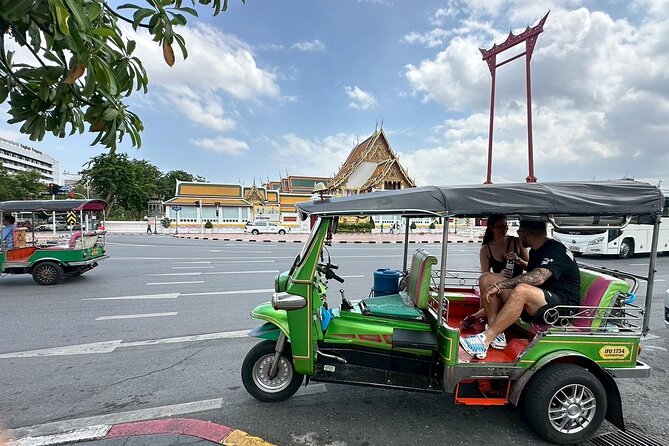
Bangkok’s tuk-tuk ride is the point here, not simply a way to get from one temple to another. For two hours, you zip through Old Town streets, pause at major sights, and let a local guide handle the route, traffic, and driver negotiations.
I like the smart end point near Wat Mangkon MRT Station, which leaves you in Chinatown with an easy ride back to your hotel. I also like the mix of famous landmarks and everyday Bangkok scenes, especially the flower market and Yaowarat. The tradeoff is clear: most sights are viewed from outside, so this is a city sampler rather than a temple tour.
Key points to know
- Ride Bangkok’s Old Town streets by tuk-tuk: You get the classic open-sided city ride without bargaining with drivers.
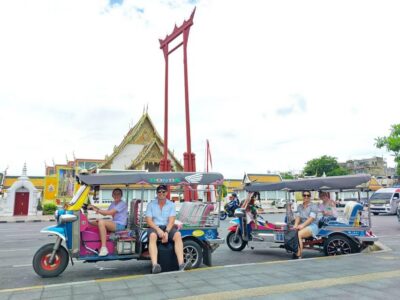
- See major sights from the outside: The Grand Palace, Wat Pho, Wat Arun, Loha Prasat, and the Giant Swing fit into a short route.
- Stop at Pak Khlong Talad: The flower market adds color, fragrance, and a look at local commerce.
- Finish in Chinatown: The tour ends near Wat Mangkon Station, close to food, shops, and Yaowarat’s evening energy.
- Guide quality matters: Betty is known for humor, a flower lesson, a flower wristband, and a stop for local delicacies.
- Good value for a short introduction: At $30.92 per person, the price covers the ride, guide, bottled water, and travel insurance, but not food or tips.
Why this two-hour tuk-tuk route works
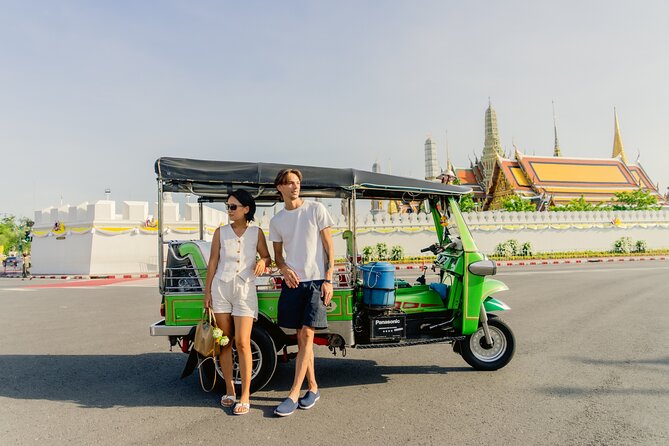
Bangkok can feel like several cities at once. Royal compounds, working markets, Chinese shop streets, river views, and traffic-choked lanes all sit close together, but finding them in the right order is not always easy.
This tour solves that problem with a compact route through the historic center. You do not need to study a map, bargain with a tuk-tuk driver, or guess which landmarks are worth a stop. The guide takes care of the movement while you watch the city pass at street level.
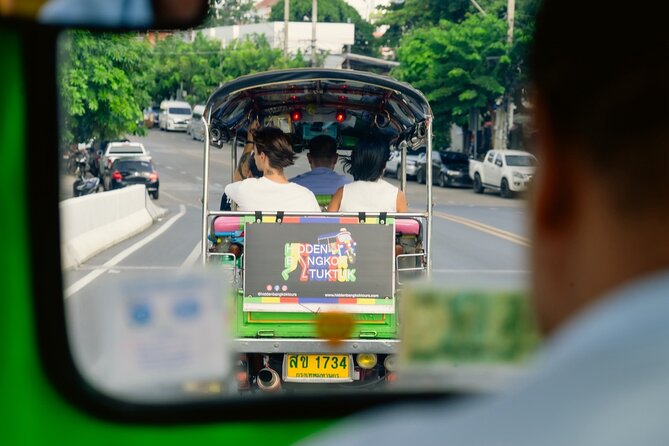
That street-level view is the main pleasure. From a car, Bangkok can seem sealed behind glass and air conditioning. A tuk-tuk puts you closer to the sound of engines, the smell of food and flowers, and the quick changes from grand temple walls to ordinary neighborhood streets.
The tour starts at 11:00 am. That timing gives you a useful middle-of-the-day activity, though it also means Bangkok may be hot and traffic can affect the pace. Since the experience lasts about two hours, it is best treated as an introduction, not a full day of sightseeing.
More tuk-tuk tours in Bangkok:
- Bangkok by Night: Temples, Markets and Food Tuk-Tuk Tour
★ 5.0 · 3,752 reviews - Bangkok Midnight Food Tuk Tuk Tour
★ 5.0 · 2,542 reviews - Bangkok: Michelin Guide Street Food Tour by Tuk Tuk
★ 4.4 · 1,274 reviews
Starting near the Grand Palace
The first major sight is the Grand Palace, Bangkok’s most famous landmark and former royal residence. Its grounds include Wat Phra Kaew, the Temple of the Emerald Buddha, one of Thailand’s most important religious sites.
You will see the complex from the outside rather than taking a full interior visit. That keeps the trip moving, but it also means you will miss the detailed work of exploring the palace grounds, checking dress rules, and spending time inside the temple compound.
Still, an exterior stop is useful. The architecture is bold and easy to appreciate in a short visit, and your guide can add context about the palace and Thai culture without turning the tour into a long lecture. If this is your first time in Bangkok, the Grand Palace gives you an immediate sense of the city’s royal and religious importance.
I would not book this tour as your only chance to see Wat Phra Kaew. Plan a separate visit if the Emerald Buddha and palace interiors are high on your list. But for a quick orientation, the stop gives you the essential view and helps you understand where Bangkok’s Old Town begins.
The river view toward Wat Arun
The route includes a photo stop with Wat Arun viewed from across the Chao Phraya River. This is one of the most useful choices on a short tour because you get the temple’s famous riverside setting without spending time crossing the river and touring the site itself.
Wat Arun, often called the Temple of Dawn, is recognized for its tall central prang and decorated surface. From across the river, you can frame the temple with the water in front of it, a better setting for a quick photograph than a rushed walk around the base.
This is a view-only stop, so keep your expectations in check. You are not visiting the interior or climbing the temple as part of the two-hour route. You are getting the postcard angle and a chance to pause before returning to the streets.
Loha Prasat and the Metal Castle
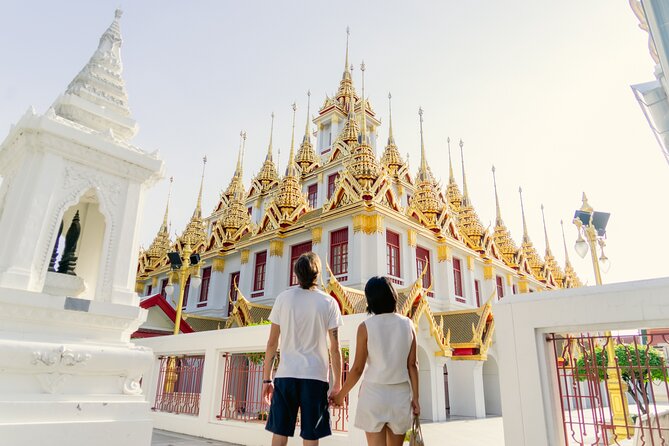
Loha Prasat, known as the Metal Castle, offers a different kind of temple stop. Located at Wat Ratchanatdaram, it is known for its unusual multi-tiered design and rows of iron spires.
Compared with the Grand Palace, this stop feels less obvious and less formal. Its shape gives you something distinctive to look at, and the site adds variety to a route otherwise filled with well-known Bangkok names.
Because the tour is short, the visit is likely to be a quick look rather than a long architectural study. That is fine for most people. You can see an unusual building, hear why it matters, and keep moving without giving up the rest of the route.
If you have a particular interest in temple design, you may want to return later for more time. The value here is the contrast. Bangkok’s religious buildings are not all glittering palace-style compounds, and Loha Prasat makes that clear.
Same city, a completely different sort of day:
- Bangkok: Damnoen Saduak Market and Maeklong Railway Market
★ 4.5 · 26,723 reviews - The Old Siam: Damnoen Saduak and Maeklong Railway Market
★ 4.5 · 10,992 reviews - From Bangkok: Ayutthaya Temples Guided Tour with Lunch
★ 4.7 · 10,535 reviews - Bangkok: Train Market & Floating Market with Boat Ride
★ 4.7 · 9,547 reviews
The Giant Swing in Bangkok’s Old Town
The Giant Swing, or Sao Ching Cha, is one of Bangkok’s most recognizable city monuments. It once played a role in traditional Thai rituals, and today it serves as a striking photo stop in the old center.
The structure is simple to understand at a glance: a huge red swing frame set against the urban surroundings. Your guide can explain its cultural role and help place it within Bangkok’s older civic and religious district.
This is another outside stop, so it does not take much time. That makes it a good fit for the tour’s rhythm. You get a clear landmark, a story, and a photo without losing half an hour to a formal admission process.
The Giant Swing also helps break up the temple-heavy part of the route. You are not only seeing royal and religious buildings. You are also seeing the public symbols that give the older city its character.
Flowers, orchids, and a local market lesson
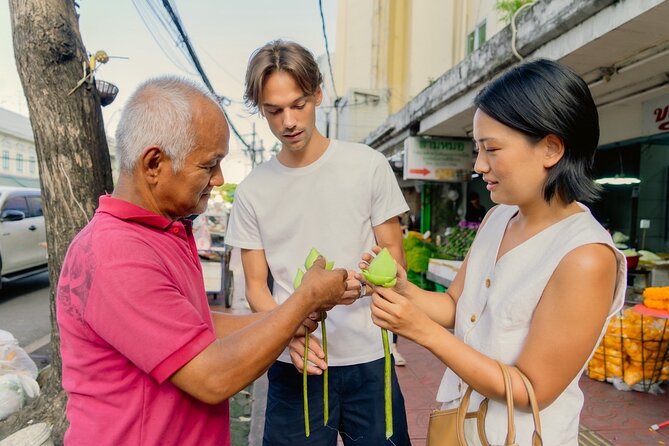
Pak Khlong Talad, Bangkok’s famous 24-hour flower market, may be the most rewarding stop for anyone who wants a closer look at daily life. Vendors sell fresh flowers and orchids, and the market brings strong color and scent to the route.
This stop has more texture than a quick landmark photograph. You can watch flowers being arranged and sold, see the work behind Bangkok’s temple offerings and celebrations, and get a sense of how a market functions beyond the tourist center.
The guide can make a real difference here. Betty, one of the guides associated with this experience, is especially noted for giving a flower lesson, handing over a flower wristband, and adding small cultural details. If she is leading your ride, expect a personal touch rather than a simple walk past the stalls.
The market is still a working place, not a staged attraction. Be respectful with photographs, keep close to the guide, and remember that the tour does not include food or purchases. You may want to bring a little cash if you hope to buy something, but no purchase is required for the visit.
Ending in Chinatown near Wat Mangkon
The tour ends near Wat Mangkon Station, identified as BL29 on Bangkok’s MRT Blue Line. This is a practical finish because you are not dropped at an isolated roadside location. You can take the MRT back toward your hotel or continue exploring Chinatown on foot.
The end point also makes sense as part of the sightseeing. Wat Mangkon is in Bangkok’s Chinese district, close to Yaowarat Road, gold shops, traditional Chinese temples, markets, and street food.
The timing matters. A two-hour ride can introduce Chinatown, but it cannot cover the whole district. I would treat the final stop as an invitation to stay longer. Once the formal tour ends, you can choose a meal, explore the shopfronts, or continue along Yaowarat at your own pace.
Food is not included, which is reasonable for a route built around sightseeing. It also gives you control over what and where you eat. If your guide makes a brief stop for a local delicacy, as Betty did on one especially well-praised outing, regard it as an extra moment rather than a promised meal.
What the tuk-tuk ride feels like
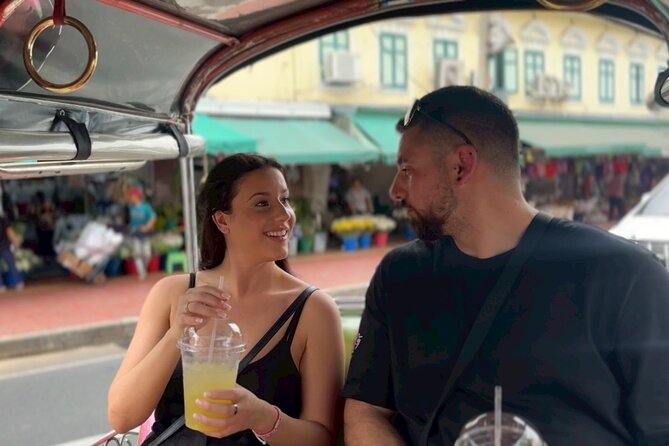
A tuk-tuk is noisy, open to the street, and exposed to Bangkok’s heat. That is part of its charm, but it is also the main comfort consideration.
You will notice the traffic more than you would in an air-conditioned taxi. The short ride lets you watch shopfronts and side streets pass close by, but the sound of the engine and surrounding vehicles can make conversation harder at times.
The tour is described as a two-hour hop-on hop-off tuk-tuk ride. In practical terms, expect a guided sequence of rides and stops rather than a free-roaming transport pass that you can use all day. The route is arranged around the listed sights and finishes at Wat Mangkon.
Group size can reach 30 people. That is not a tiny private outing, and the experience may feel less personal when the group is full. On the other hand, the guide can keep the route organized, and the short format limits the amount of time spent waiting.
A licensed English-speaking guide is included, along with bottled water and travel insurance. Those details matter in Bangkok’s heat, especially since you will be getting in and out of the tuk-tuk for several stops.
Is $30.92 a fair price?
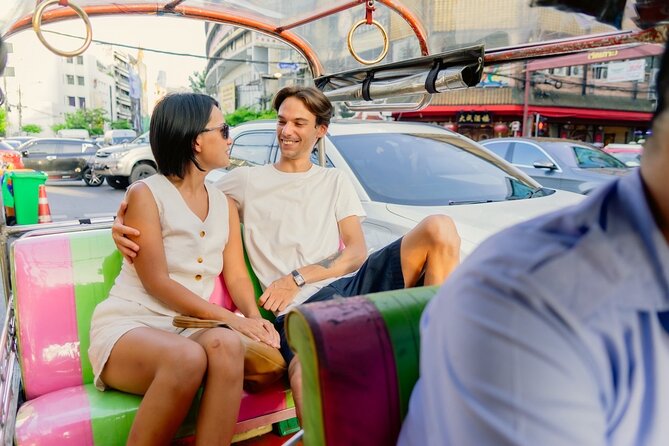
At $30.92 per person, this is not the cheapest way to take a tuk-tuk across Bangkok. You are paying for more than the vehicle. The cost includes a planned route, an English-speaking guide, bottled water, and travel insurance, with the convenience of no driver negotiation.
The value is strongest if you are new to Bangkok, have limited time, or want a quick overview before choosing what to revisit. A local driver might charge less for a short ride, but would not necessarily provide the same context or take you to this set of stops in a sensible order.
The value is weaker if you already know Bangkok’s Old Town well or want long visits inside the Grand Palace, Wat Pho, and other temples. Since most sites are viewed from the outside, you are paying for breadth and ease rather than detailed sightseeing at each monument.
I also like the open-ended finish. Ending at Wat Mangkon Station means your paid experience does not trap you in a return transfer. You can use the MRT, eat in Chinatown, or continue exploring without arranging another ride.
Who should book this Bangkok ride?
I would recommend it to first-time visitors who want to get their bearings quickly. It also suits couples, families, and short-stay visitors who want a memorable local transport experience without sorting out the route themselves.
It is a good choice if you value stories and small cultural details. A guide such as Betty can turn a flower-market stop into something more personal, with humor, a simple lesson, and a flower wristband rather than just another photograph.
You should think twice if your priority is entering every temple or spending a long time at each landmark. This tour moves quickly, and the outside views are part of the design.
The route may also be less appealing to anyone who dislikes heat, traffic noise, or open-air transport. Bangkok traffic can slow the ride, and the maximum group size of 30 means this is not guaranteed to feel private.
Book at least a day ahead if your plans are firm. The experience is often reserved well before the date, with an average booking time of 26 days in advance. Free cancellation is available if you cancel at least 24 hours before the 11:00 am start time. Changes or cancellations inside that window are not accepted for a refund.
Final call on the two-hour route
I would book this tour if I wanted a fast, well-planned introduction to Bangkok’s historic center, especially on a first visit. The mix is strong: tuk-tuk travel, palace architecture, a river view, an unusual temple, the Giant Swing, a working flower market, and Chinatown.
I would not book it as a substitute for a full temple day. Think of it as a lively city overview with useful transport and a smart finish near the MRT. At a reasonable price for the guide and planning, it gives you enough of Bangkok to help shape the rest of your stay.
FAQ
How long does the Bangkok tuk-tuk tour last?
The tour lasts approximately two hours.
What time does the tour start?
The tour starts at 11:00 am.
Where does the tour begin?
The tour begins at Sanam Chai in Bangkok.
Where does the tour end?
The tour ends near Wat Mangkon Station, also known as MRT Blue Line station BL29, in Chinatown.
Are meals included?
No. Food is not included in the tour price.
How far in advance can I cancel for a full refund?
You can cancel at least 24 hours before the experience start time for a full refund. Cancellations or changes made less than 24 hours before the start are not accepted for a refund.
More 2-Hour Experiences in Bangkok
- Bangkok Canal Tour: 2-Hour Longtail Boat Ride
★ 4.5 · 5,909 reviews - Bangkok: 2-Hour Canal Tour by Teak Boat
★ 4.1 · 2,212 reviews - Bangkok: 2-Hour Dinner & Shows on White Orchid River Cruise
★ 3.9 · 897 reviews - Bangkok: 2-Hour Dinner Cruise on the Chao Phraya Princess
★ 4.0 · 73 reviews
Newly reviewed around Bangkok
- Suvarnabhumi Airport (BKK) Private Transfer to Bangkok Centre★ 3.5 · 5 reviews
- CTB Unlimited Hop CHAO PHRAYA RIVER: All Day River Pass★ 3.5 · 50 reviews
- Nopparat’s Traditional Thai Dinner & Dance★ 4.0 · 19 reviews
- Half-Day Bangkok Off-the-Beaten-Track Tour: Rural Villages and Khlongs★ 5.0 · 40 reviews
- Half Day Bangkok Food and Sightseeing Tour★ 4.5 · 10 reviews
- The Story of Handicrafts Full Day Experience from Bangkok★ 5.0 · 3 reviews
- Chinatown (Yaowarat Road) Neon Photoshoot★ 5.0 · 12 reviews
- Nakhon Nayok adventure full day trip with lunch★ 5.0 · 20 reviews
Bangkok Tuk-Tuk Tours, compared.
Bangkok by Night: Temples, Markets and Food Tuk-Tuk Tour
Read our review →
Tuk Tuk Adventure Chinatown Michelin Food & Temples
Read our review →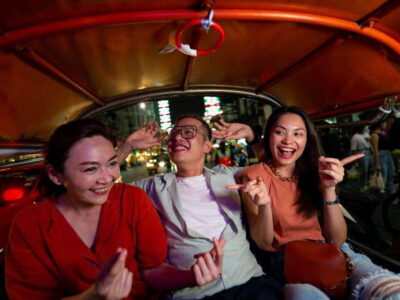
Evening Tour with Wat Arun, Wat Pho & Tuk Tuk Ride
Read our review →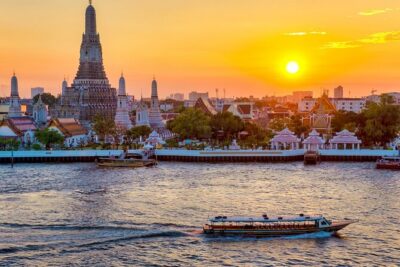
Bangkok Tuk-Tuk Tour by Night with Chinatown Street Food Meal
Read our review →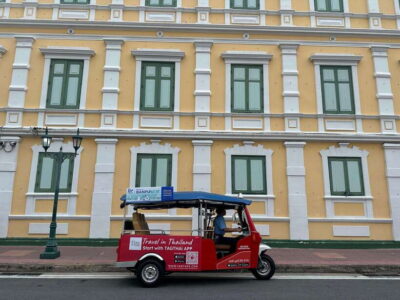
Browse the lists this tour appears in